"They knew the real secret. They knew that the magic is in the child, not in the materials..." - Glenn Doman
"Tiny kids can learn anything that you can present to them in an honest, factual way. If you give them the facts they'll deduce the laws that govern them. That is exactly the same method that scientists use to discover laws. So don't give them theories and abstractions, give them facts, give them reality. From the facts little children are brilliantly able to intuit the laws." -Glenn Doman
Damien is my one year old. In this post I am going to share about my "curriculum" for him, or the learning activities we do in our homeschool.
Right now Damien is so much fun to observe, be around, play with, and teach. He just turned 14 months is saying multiple new words on a daily basis, both one- and two-syllable (
like "dino" and "apple" and "baloo[n]"). He can repeat almost any word we say to him, when he wants to.
He pages through our substantial collection of books nearly nonstop every day. When given the chance to go outside, he is nonstop on the move, walking, walking, exploring, and sometimes (
almost) running.
He loves being read to, talked with, tickled, played goofy games with, and doing bit cards (
flash cards) together.
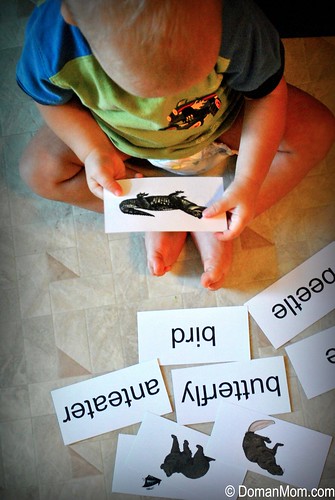
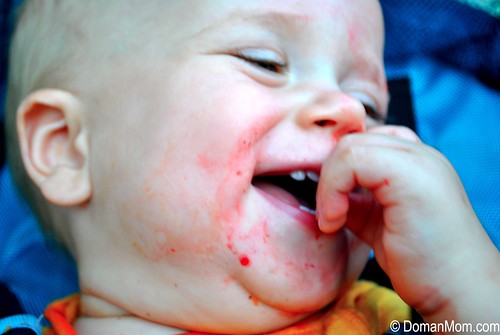
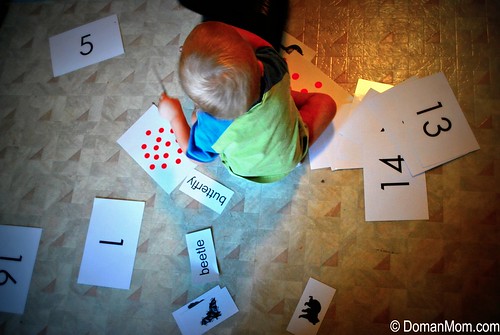 Damien making a mess getting out his bit cards
Yes, I use flash cards with my baby. No, it does not mean that I strap him to a chair and drill and test him for three hours a day.
We use flash cards in the very same way that other people use board books -
it is just showing a baby words, pictures, and talking about them together. They are just another fun learning toy we play with. They take but a
few moments several times a day (
sometimes not so often) and
he loves them and, in fact,
begs for them and demands them. I present them in
fun, game, and merriment, and it is a great
few-minute addition to our little routine.
"Babies are learning every minute of every day and we're teaching them - whether we know it or not. The problem is that it may be bad to be teaching them if we don't know we are. We may be teaching them things we don't actually intend to teach them. Most often we are unintentionally teaching them things that aren't worth learning - or at least aren't as worth learning as the things they could be learning and learning much more quickly and easily." -Glenn Doman
However most of our day is spent like this:
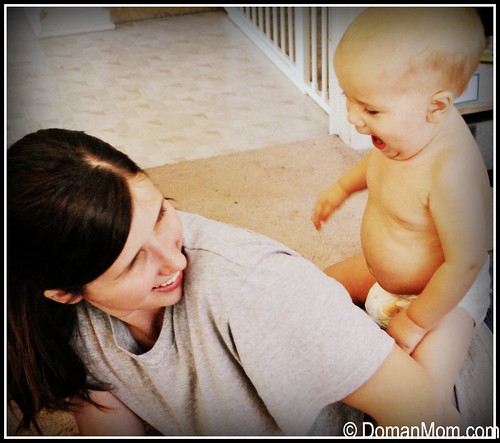
Or this:
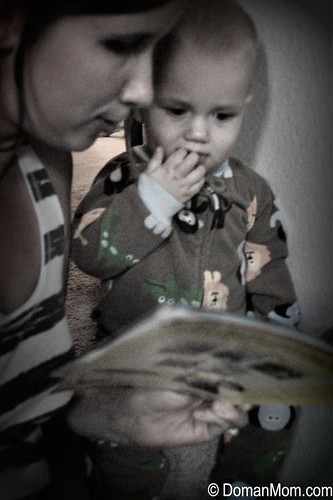
Or this:

Or this:
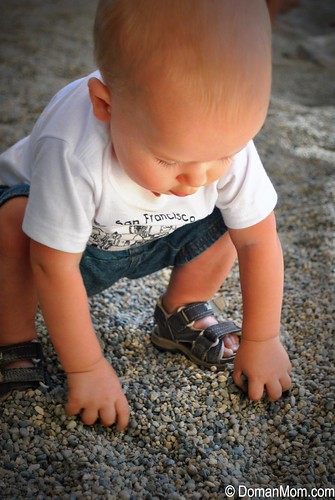
Damien has a very normal toddlerhood. He spends 90% of his day
freely playing with toys, books, his brother, exploring the house, eating, nursing, napping, being snuggled and adored and talked to. The other 10% (
on a good day) involves other wonderful but not so common (
and often misunderstood) activities like playing with
flash cards for a few moments together, listening to classical music or notes being played on the piano, coloring with crayons, fun little planned games and toys for developing small motor skills, going for walks, doing little games to promote balance, and so on.
It is all fun and games to him and no one has ever told him that watching Teletubbies is more fun than math or exercise, and it turns out babies aren't born with that bias.

I keep track of our activities in a little binder and all of our bits cards (
flash cards) go in our "bit bag". I will write later on how we organize and keep track of our activities as well as the printables I created.
Damien's Curriculum, K1
(Ages 12 through 23 months)
Reading
“Very young children can and do learn to read words, sentences, and paragraphs in exactly the same way they learn to understand spoken words, sentences, and paragraphs." - Glenn Doman
We use ideas from Glenn Doman's
How to Teach Your Baby to Read.
I know some people cannot comprehend a baby being able to easily (
and joyfully) learn a task that most adults struggle painfully for many months or years to teach to 5, 6, and 7 year olds. But I have found baby reading to be very enjoyable and simple.
Learning to recognize written words is actually a lot less complex than learning to successfully recognize spoken words (
with its varying tone, inflection, accent, speed, and so on that we bombard babies with) yet virtually all children become fluent in the spoken English language before their second or third birthday and understand much of English before the age of six months. Yet we never blink an eye at adults bombarding infants with spoken languages.
Written English is much more straight-forward, consistent, and clear, and it turns out that if we present written English to babies in a clear, large, factual way (
just as we speak to them in clear, loud, straight-forward speech)
they can successfully learn to read (
fluently, by sight and phonics)
before their second or third birthday and recognize/understand many written words long before then.
But I am getting ahead of myself, and the topic certainly deserves a post of its own! Baby reading involves
showing babies whole words (
just as we speak to them in whole words, obviously) and initially the baby will simply "memorize the shape" but not long after he will begin to
observe patterns, deduce the laws that govern them, (
just as all babies do with English speech and grammar)
and begin to read phonetically.
Content: The goal is to go through about
50 words per week (
he loves them!) although we won't always be that consistent. Right now he is just doing
single words, such as family member names, animals, objects, colors, and so on, usually accompanied with
pictures on the flip side of card. Soon I am going to introduce some (homemade)
simple sentence books for him.
Alphabet: I also explicitly teach him phonics and he currently knows the
sounds of about half of the letters of the alphabet (
uppercase). We are going to finish with the sounds of the uppercase letters and then introduce the corresponding lowercase letters, and at some point introduce the names of the letters. Also later introducing letter combination sounds (
ch, sh, igh, and so on). He really loves his letters and gets very excited when we play with them in the kitchen, bath, or during diaper changes.
Literature: Damien is usually right along with there with his
older brother when we read classic literature, poetry, and the Bible together as a family.

Writing
Using activities from Glenn Doman's
How to Teach Your Baby to Write. In the booklet, the author states that
writing is not just the physical act of putting a pen to paper. If Shakespeare would have had a secretary record his words as he composed them, would his works have been any less great, or any less his? Certainly not.
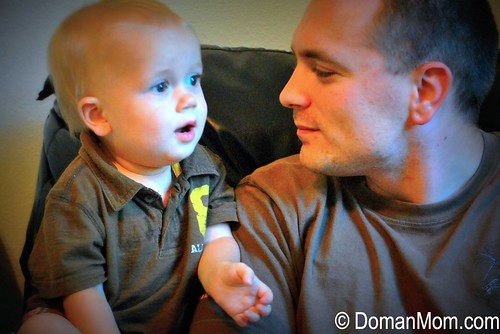
Writing, they say, is a creative process that can begin long before your baby can form letters with a pencil. You can start with your baby at any age. Once a day, have a journalling session where you ask them questions and wait for their answer. Babies of just a few days or weeks old will respond and "talk" to you. We usually ask simple questions, such as "How was your day? What was your favorite part of today? What was your least favorite part?" Then record the questions and their responses.
The better their speech the more detailed their responses will be. This little activity is a great way to
"give baby a voice", a great memory maker, and great language development game, and a great way to teach them what writing is (
putting ideas to words / paper) and give them a
desire to want to do it themselves. Later on the physical act of writing is introduced, but tracing words before tracing letters.
I also during our nightly writing sessions (
they don't happen every night but when we can)
let him draw and color on his journal page. I give him a choice of two different colored markers and he makes the most beautiful "pictures"! He is also learning fine motor skills and pencil control in doing this.
Language Development
"With few exceptions, the more parents talked to their children, the faster the children's vocabularies grew and the higher the children's IQ test scores were at ages three and up."
-Drs. Betty Hart and Todd R Risley in Meaningful Differences in the Everyday Experiences of Young Children
Conversation is such an
important part of overall development and the ideal goal
according to this study is
17,000 words a day for the first three years of life. So we try to do a lot of talking around here, both talking to my baby as well as talking with him (
waiting for and listening to his responses, having back and for conversations, and so on).
We also do
American Sign Language, but not nearly as much as I thought we would, as he verbalizes well and I am more focused on teaching him spoken words and pronunciations.
Math
"Always remember that math is a game. It is fun! It is playing with your baby." - Glenn Doman
We use the activities from Glenn Doman's
How to Teach Your Baby Math and the
Math for Mothers (I-III) booklets by Glenn Doman from the
Gentle Revolution Press.
Baby math involves
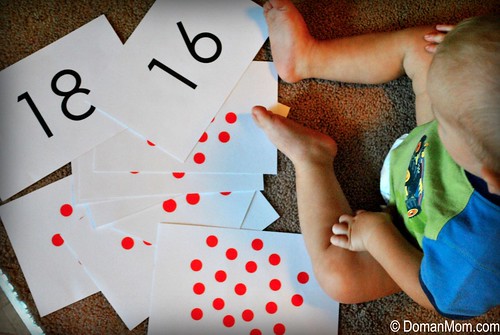
using cards with randomly placed dots to teach quantities first before teaching counting. The baby does not count the dots but
subitizes them. That is, can tell that a card with
55 dots has more than a card with 54 dots, instantly, an ability they will loose before their second or third birthday. So the
names of the numbers are taught to the baby and then
arithmetic can be taught. It in
no way resembles the way you teach your first grader math and is a great deal of fun and only takes a few seconds a day.
I have no scientific studies to demonstrate that babies have this ability but
witnessed it with my first born son when he was two and three (
he kept the ability a little longer than "average") and it is phenomenal to say the least.
Counting: We also do
count things around the house frequently,
talk about numbers and shapes and positions and so on, and twice a day since he was seven months old (
when I lay him down for nap and bed) I
"sing" from 1 to 100 in the tune of twinkle twinkle little star. It has gotten to the point where I can't lay him down without singing that first. Looking forward to the day he sings back.
Encyclopedic Knowledge
"Babies can learn absolutely anything that you can present to them in an honest and factual way and they don't give a fig whether it's encyclopedic knowledge, reading words, math, or nonsense for that matter. They'd prefer great things - reading, math, all the presidents of the United States, the nations of Europe, the great art of the world, the song birds of the eastern states, the snakes of the world, the kings and queens of England, the great music of the world, the international traffic signs, the dinosaurs, the state flowers, or any of the millions of fascinating things there are to know about on this old earth. But they'll even take nonsense if that's all they can get." - Glenn Doman
We will be
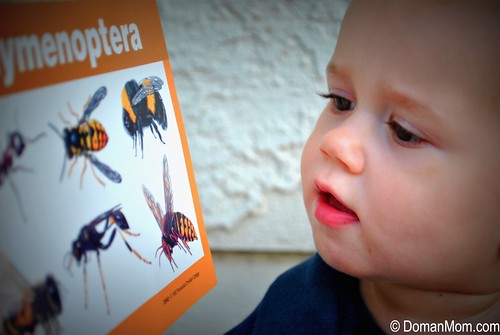
learning the names of lots of beautiful and interesting things this year by way of reading books together and also playing with "bit cards" (
flash cards) via the ideas in Glenn Doman's
How to Teach Your Baby Encyclopedic Knowledge.
For simplicity's sake, everything there is to know is organized into 11 categories (
Art, Biology, General Science, Geography, History, Human Anatomy, Languages, Literature, Mathematics, Music, and Scripture) and we'll pick maybe
5-10 facts from 5-6 categories per week (
or every other week) to learn about.

Physical
Using ideas and simple exercises from Glenn Doman's
How to Teach Your Baby to Be Physically Superb. The physical program involves things like going for daily walks together, walking on different terrains (
bumpy, hilly, sandy, etc.), stair climbing, and crawling (
on hands and knees as well as "army crawling").
The
balance activities are things like
holding your baby in your arms and gently spinning,
lifting baby up and down and side to side, and lots of other things that parents naturally do when they play with their baby. Their are also fun little things like
rolling on the floor, doing somersaults, walking on a balance beam, and so on.
The
manual program involves
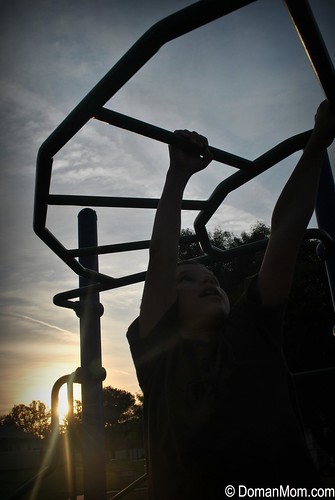
hanging from a bar, doing
brachiation [monkey bars], and
small motor activities like pouring and transferring.
Swimming: Swimming activities using Glenn Doman's
How to Teach Your Baby to Swim. Right now this involves
swimming underwater (
by himself),
back floating, jumping in the pool, climbing out of the pool, splashing, and being cute. Will hopefully be able to keep up our fantastic summer progress over the winter and during our travels. You can read about our activities
here.

Sensory
Also part of the physical program is
sensory activities.
Tactile: Just fun one-year-old stuff like
water play, play dough, art activities like
painting, helping out in the kitchen, playing with dry rice/beans/pasta, texture material samples, and so on. I don't do these things as often as I would like to but I am hoping to be more consistent over the fall. Also, he tends to make up his own sensory experiences
Auditory: Conversation,
talking about sounds we hear and
where they're coming from, naming
piano notes, and so on.
Olfactory, Gustatory (smell, taste): Mostly
unplanned, impromptu experiences while helping out in the kitchen: smelling spices, ingredients, tasting things, and so on.
Visual: Visual stimulation is now in the form of the
reading, math, and encyclopedic knowledge games as well as
talking about sights that we see.

Small Motor
Lots of
home made and store-bought toys that encourage small motor skills, thinking, and problem solving. Fitting various objects into various spaces and holes, puzzles and manipulation toys, object stacking, sorting, pouring and transferring, and so on.

Life Skills
Little
Damien loves to "help out" around the house and do what we're doing. Of course at this point it is anything
but "helpful". But I have learned the value of allowing babies to
participate in real life instead of being shooed away to play with their toys or watch TV all day. Some benefits I've observed:
- It brings about many opportunities for vocabulary building and conversation
- It provides lots of great impromptu sensory experiences
- It provides lots of problem solving and learning opportunities as babies can observe how things work (such as how a screw driver turns a screw, the hot water changes the texture of the pasta, etc)
- It provides lots of small motor opportunities, such as sorting, pouring, carrying, turning, and so on
- It helps build good behavior as babies get a chance to practice self control and follow directions
- It builds your relationship with your child in a powerful way
- It builds confidence and self esteem as the child knows that he is needed, wanted, valuable, and useful (rather than just being "told", he gets to experience and live it)
- It builds children with a great many skills and a strong work ethic - they may not be much "help" in the very early years, but you will be reaping the benefits of teaching your children to work while they are young for years on end. As experienced with my first child, by the time he was two and three he was a genuine help in many areas. By four he was a noticeable help around the house. At seven he is a substantial and significant help in all household tasks - more capable and helpful than many ten year olds and even some teens I have known in our post-modern America.
So what does Damien do? Everything he can! I like to bring him along with me while I do laundry, cook, fold clothes, organize, work at my desk, clean, and whatever we are doing. With help, he picks up his own toys, takes his diapers to the trash, and takes his clothes to the hamper. He "helps" in fun cute ways and loves to be with his parents and big brother!
Out and About
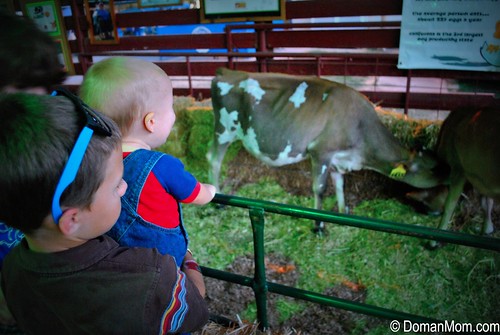
We like to get out of the house - go to
the farmer's market, the grocery store, the fair, the zoo, the park. Most weekends at least we are out as a family going somewhere interesting.
So that is our little homeschool program for Damien.
Maybe it sounds like a lot (
or maybe it doesn't)
but it's really just become a part of our life, a part of our routine, as normal as wiping messy faces and making lunch and giving kisses. Most of our little
flash card sessions happen right before and after daily routine tasks - mealtimes, diaper changes / potty times, naps, bathes, and so on. I hope you've found this post interesting and informative.
To see what big brother's curriculum plans for the year are, you can go
here.
“And these words, which I command thee this day, shall be in thine heart: And thou shalt teach them diligently unto thy children, and shalt talk of them when thou sittest in thine house, and when thou walkest by the way, and when thou liest down, and when thou risest up. And thou shalt bind them for a sign upon thine hand, and they shall be as frontlets between thine eyes. And thou shalt write them upon the posts of thy house, and on thy gates.”
Deuteronomy 6:7-9
 Damien is currently 14 months, 0 weeks old (grade "K1")