Showing posts with label Gifted and Prodigies. Show all posts

Monday, November 1, 2010

Doman Quote of the Month: The Land of Knowledge

"At this moment there is a world - a world of great beauty, of great truth, an enchanting, beguiling, thrilling, bewitching, and enriching world of facts - out there in fact land. It is a land of great riches. There are riches for the soul, there are riches for the spirit, there are riches for science. It is a land beyond imagining, but strangely it is very uncrowded. It is crowded only in spots. There are lots of artists looking at great paintings, and there are lots of musicians listening to orchestras, and there are lots of scientists looking at space shuttles, and there are lots of doctors looking at hearts, and there are lots of mathematicians looking at numbers, but very, very few people are seeing it all... They're a group called "Genius"... True geniuses have always been few in number and immensely curious about everything."
Glenn Doman
How to Give Your Baby Encyclopedic Knowledge

Sunday, September 26, 2010

Jones Geniuses Matrix Math® Review (ages 2-6)

A simple Matrix Math® practice sheet
"Any fool can make things bigger, more complex, and more violent. It takes a touch of genius - and a lot of courage - to move in the opposite direction." 
Albert Einstein
A couple of weeks ago, Dr. Jones from Jones Geniuses Accelerated Education sent me his Early Learning Kit for review.

The Early Learning Kit has both a reading and math curriculum (Threshold to Reading® and Matrix Math®), but for the purpose of this post I will only be discussing the Matrix Math portion. (Please stay tuned for upcoming Threshold to Reading® review).

What It Is

The Matrix Math® is the first (Level One) program in the Jones Geniuses' math curriculum. Jones Geniuses math programs cover basic to advanced arithmetic and number concepts all the way up to algebra and geometry, and does so on a level far exceeding most traditional math programs. Jones Geniuses Math Programs are intended to advance students approximately four times faster than traditional math education, while at the same time utilizing advanced standards and techniques (such as rapid calculation with large numbers and difficult operations, systems for instantly memorizing long lists of numbers, and so on). (See our introduction to the company here)

Matrix Math®, the first level program, focuses primarily on introduction to number concepts, addition, and subtraction, by the use of a special "dot matrix". The program is geared toward 2-6 year old children, although it could possibly be adapted for older or younger students depending on ability. Matrix Math covers:
  • Numbers (actual quantities)
  • Numerals and numeral writing (symbols for numbers) 0-9 and above 
  • Counting forwards and backwards (one-to-one correspondence) to 20, then to 100
  • Greater than and less than concepts
  • Addition and subtraction skills with numbers 0-20

How it works 
Hunter practicing the placement of the dot matrix 
ma·trix [mey-triks] -noun 
1. something that constitutes the place or point from which something else originates, takes form, or develops

The foundation of the Matrix Math program is the dot matrix. The dot matrix is a simple yet ingenious system of intentionally placed dots within numerals, that teaches children the actual quantities behind the abstract symbols. The numeral 7 has seven dots in it, the numeral 9 has nine, you get the picture.

These simple dot-numeral hybrids are used to teach children quantities and numerals
at the same time and as the same thing, counting, greater than and less than comparison, how to write numerals, and, most importantly, addition and subtraction.

You may have seen (
or heard of) the idea of placing dots inside of numerals to teach small children the realities behind the symbols, such as this example here. But herein lies the uniqueness of the Jones Geniuses dot matrix system:

  • The dots within the dot matrix are intentionally and logically placed, for the purpose of memorization. For example, every circle contains four dots, and every long line contains either three or five dots.
  • The dot matrix is used to teach addition and subtraction with dot matrix based manipulatives and worksheets. Children count the dots, starting at the larger number (instead of starting all the way at one) and then count up (or down, in subtraction) as they touch each dot within the smaller number. For example, "8" is touched and named in 8+4, then the child touches each dot in the "4" as he counts up from 8, reaching the final answer, 12.
  • The dots are counted in a specific order, so children learn not to double-count (or skip) dots on accident.
  • The dots are made to be memorized. Initially, children practice addition and subtraction with these "special" numerals, but the purpose of the program is to memorize the placement of the dots so that they can be used as aids in regularly-written numerals, even when they're not there. This is taught by writing dots inside of blank numerals (see picture above) in daily exercises, exactly and precisely, so children quickly move from "matrix" equations to regular equations, using their pencil to count imaginary dots in each numeral.
  • The dot matrix, once memorized, can be used throughout the child's life, since our's is a 0-9 based numeral system. It can be used for larger numbers, such as 173+285, and also can be used in multiplication and division, for example counting by threes while touching the dots in the "9" of 9x3. These skills are taught in future levels.

Our Experience with the Program
Hunter, as you probably already know, was a little bit "past" this level in most senses, as he could already count, understand quantities, greater than and less than, write numerals, and so on. But nonetheless, I think he highly benefited from the use of the program and by learning this amazingly clever dot matrix tool!

As you might know, we have had an interesting and sometimes perplexing road after using Glenn Doman's How to Teach Your Baby Math program over three years ago. I would do the program again in a heartbeat, and Hunter has often times amazed me with his mathematical abilities, including being able to instantly solve large equations without counting, fill in the blanks in algebra equations, effortlessly grasp concepts, and so on. But his ability to solve answers visually (with aids) never translated into being able to solve answers auditorily, or even on paper.

This program has been an amazing "next step" for us, and after quite a while of not doing very much math since we didn't know
what to do or how to go about things, Hunter is once again excelling (and I can't wait to see what the next levels have in store for us!) After just a little over a week of daily working on the program, he had memorized the dot matrix exactly and was able to graduate to their numeral-only equations, and is flying through them!

Why it is Accelerated (and better) 
There are a lot of things that I enjoyed about this program, but the main benefit is that it is clear, understandable, and accelerated. Accelerated does not just mean that you go through the same material faster - it means you go through the same material better!

It does this by:

1. Streamlining and simplifying, doing away with "crutches" such as counting on fingers or with beads. It gives kids a useful, efficient, long-term, and easier tool that they don't have to be painfully weaned off of!

2. Skipping the "start counting from one" step for addition, teaching kids from the beginning to begin the equation by counting from the bigger number, which is much more efficient and common sense.

3. Teaching addition and subtraction as inverses, doing away with the all-too-common problem of children who are strong in addition and weak in subtraction (because kids always count forwards but rarely count backwards). They teach you to count backwards with your child every time you count forwards, and every math session is composed of equal attention to both addition and subtraction. This makes for children who are not only strong from the start in both essential skills but understand the concepts better since concepts are most easily understood as contrasting opposites.

4. Teaching a speedy method of computation, since, as every phonics teacher knows, speed produces comprehension. If it takes a child five minutes to "sound out" the sentence "the car is driving fast", the child won't understand what he just "read". The language of mathematics is the same way, and by using the quick and efficient tool of the dot matrix, children are able to better understand and retain the information, not just "going through the motions" without truly internalizing what is happening. Speed also complements memorization and helps children to be able to instantly solve equations, faster, sooner.

5. Instilling confidence by helping children succeed, and therefore, keep going and keep learning, doing away with the unfortunately all-too-common math phobia. When you're not good at something, you avoid it. When you are good at something, you're drawn to it. A motivated child will excel for the love of the subject.

Pros:
  • Logical, thorough, accelerated - The program is, I believe, a beautifully-designed, well thought-out, thorough program, saving you and your child time, money, and frustration, while producing excellent mathematicians. What better pro could there be than that?
  • Early start - The program is simple enough to begin as soon as your child can talk, usually around age two, since math is a language just as is English, and the program is designed to emphasize such.
  • Easy to understand - The curriculum is well-organized and easy to understand.  The DVD and instruction manual explain each step carefully and clearly, making it simple and straightforward for the parent.
  • Individualization - All the programs are not age-based but skill-based, doing away with the "one size fits all" mindset found in most math curriculum.
  • Excellence in education and attention to detail - High expectations, true mastery, and precision are core character traits incorporated into the program, which are taught gently and joyfully to small children early on.
  • The belief in joyful and early teaching - Just like Doman, Dr. Jones believes learning should be joyful, fun, and gentle for the child.
  • Wonderful customer service - So far, all my dealings with the company have been wonderful, including quick responses to emails, friendly, in-person phone consultations (for free) and extremely quick shipping.
  • Non-profit company - Always a plus, Jones Geniuses Accelerated Education is a not-for-profit company.
  • Reasonable price - Less expensive than most other math curriculums, yet delivers so much more!

Cons:
  • Sturdiness of materials - The materials are printed on regular computer paper (posters, reproducible worksheets) or plain card stock (flash cards). This was a con for me because they are somewhat fragile and not "kid proof". This was easily solvable with some simple lamination, though, so nothing big here.
  • Print quality - Overall, I think the print quality was fine, but there were a few instances (perhaps 2-3) where the material's printing was "off center", making it difficult to complete the worksheet. I'm sure this was just an individual printing mistake and not present in every program, though.
  • Website description - This is not a con with the program itself, but rather for prospective buyers. I would have liked to see a more complete and comprehensive package description easily accessible on the website of what all is included, further details about the program and its implementation, and better pictures of the individual items before making the choice to purchase. With what an amazing program it is, I just don't think the site does it justice.

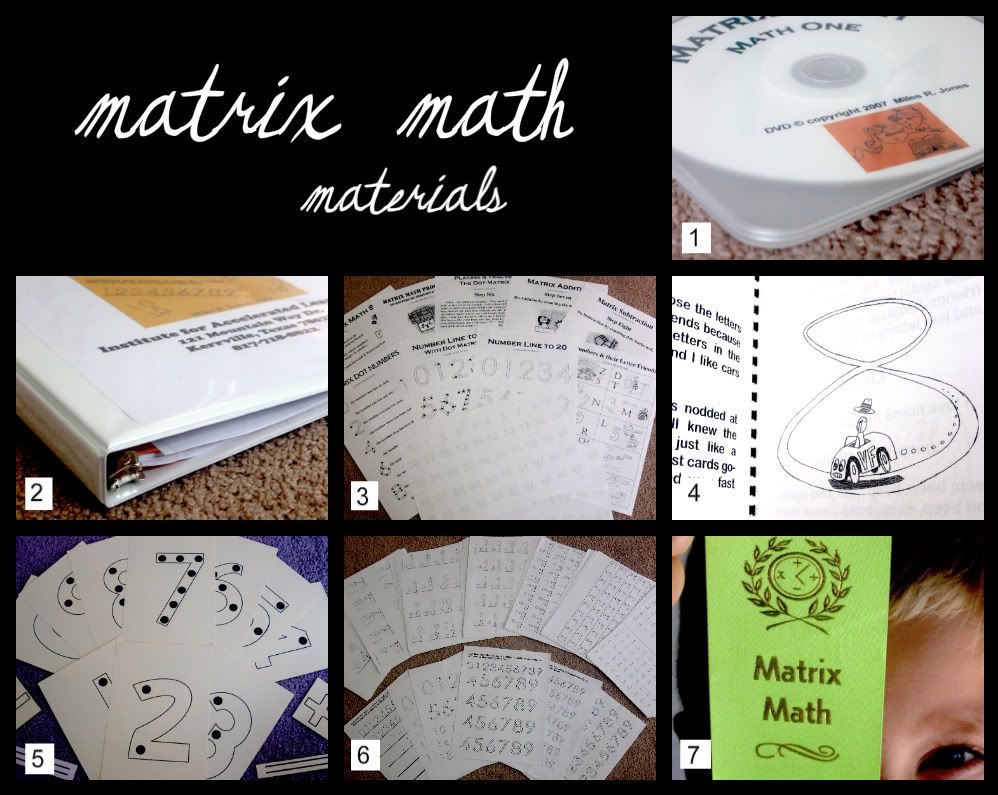
What is Included in the Program
Included materials (click to enlarge)
1. A fifty-minute instructional DVD (for the parent) that carefully covers each step of the program, early learning philosophies and teaching, how to use the materials, child demonstrations, and more.
2. A 36-page instruction manual (for parent) with an introduction to accelerated education, early learning and brain development, how to implement each step of the program, suggested activities, how to motivate your child, parent's perspective, and more.
3. Eleven 11x17" posters, including blank number lines (up to 100), dot matrix number lines and dot-placement posters, number-letter memory association graph, Matrix Math steps, worksheet challenge progression, and addition and subtraction demonstrations.
4. A 34-page How the Numbers Made Friends with the Letters storybook, which introduces children to the number-picture associations that are used in later levels for advanced memory techniques.
5. 0-9 Matrix manipulatives and operator symbols (+, -, =), which are 8x5.5" flash cards that are used for teaching counting, greater and less than, and initial addition and subtraction.
6. Seventy-one 8x11" reproducible, leveled worksheets, which gradually and gently progress children from doing 4 extra-large print, dot-matrix-based addition and subtraction equations per session to 100 small print, regular-numeral addition and subtraction equations per session (65 pages), as well as dot-matrix fill-in-the-blank and numeral writing worksheets (6 pages).
7. Beautiful, gold-lettered award ribbon for being a "Matrix Master" after graduation from the program

Matrix Math can be purchased individually (special order) for $100 plus tax from Jones Geniuses Accelerated Education, or together with Threshold to Reading for $160.00 (a 20% discount) when you buy the Early Learning Kit.

Jones Geniuses Accelerated Education sent us an Early Learning Kit to facilitate this review. All opinions expressed are my own and I was not otherwise compensated for this review.

Hunter, at time of using the kit, was 5 years, 5 months old

Wednesday, July 28, 2010

Upcoming Review: Accelerated Education Curriculum


"Make everything as simple as possible, but not simpler."
Albert Einstein 

One problem I have had in homeschooling is that so far in my five or so year journey, I always seem to have to reinvent the wheel.

On one hand it has been because I have always had very little money to work with and therefore instead of buying a curriculum, I would just make my own.

On the other hand, and the far more prominent reason I always found myself "reinventing the wheel" and making my own curriculum, was because I could never find anything that was suited to my and Hunter's wants / needs. Usually just because I thought all the stuff that was intended for the "early years" was too boring / slow so I would have to [want to] take more advanced things and simplify them for Hunter's comprehension level.

But the longer I have homeschooled, the more I have felt the pull of the simplicity of a pre-bought curriculum. Not for every subject level necessarily, but at least for some things, to have it all already planned out for you would be really nice.

Math was one of those things. I knew how horribly the traditional American education model generally fails in math education. And I also knew that even most of the best private curriculums were still based off of that failing system, at least in essence if not always in exact content.

They were too slow. Does it really take six or seven years (pre-k through grade 5 or more) to just teach basic arithmetic? (addition, subtraction, multiplication and division) And what was more, you would think that after spending so much time on a subject, it would be thoroughly mastered, right? But we all know that that is not the story here.

Is math really that hard? Is it really that complicated?

I knew it wasn't, but designing my own accelerated curriculum baffled me. I have tried, and Hunter has learnt a great deal of mathematics using Doman as a jump start, but I created every schedule and sequence basically on my own and in so many areas have been lost with what do next. The thought of attempting this until high school overwhelmed me, to say the least.

That is until I found Jones Geniuses.

Jones Geniuses Accelerated Education is an accelerated curriculum developed by Dr. Miles Jones based on years of research and implementation first in the classroom and more recently in the home. The math program aims to help children learn mathematics four times faster than the traditional model and with greater accuracy and speed than most college-educated adults.

His main focus is math, but he also offers courses in speed reading, Spanish language learning, and memory training.

Dr. Jones has kindly offered to send me his first year early learning program, to try it out with both Hunter and my daycare kids. I'm very excited about what looks like an amazing program and an amazing company and look forward to sharing my experiences with you all very soon!

Update: read the full review of Math One here

Jones Geniuses Accelerated Education
"...Hear, O Israel, the statutes and judgments which I speak in your ears this day, that ye may learn them, and keep, and do them." 
Deuteronomy 5:1

Sunday, November 23, 2008

Nature or Nuture? Developing a Musical Genius


Link: Superhuman Genius - Jazz Prodigy Ariel Lanyi

The other night I saw this show on the science channel called SuperHuman. This episode focused on "geniuses". There were several people featured on the show from an art prodigy to a man with an amazing memory. Of the five people one of the was a little ten-year-old boy named Ariel Lanyi from Israel who is a pianist and composer. I have seen many piano prodigies, especially on the Internet, so seeing a child play the piano like this was amazing but nothing incredibly new. However it was what his parents said about how he developed his talent that stuck out to me the most. Right in the beginning of the show Ariel's mother says:


"There is a theory that very young children can be taught anything. They don't have to be born that way. But, the earlier you start the education, the more you'll be able to achieve."

When she first said "There is a theory that very young children can be taught anything" I thought to myself, "That has Doman written all over it!" Of course I can't be totally sure, but when they continued on to tell of an incident with two-year-old Ariel in the car, it sounded even more like Doman. He told the story of when Ariel was two-and-a-half and they were driving in the car, and his dad recognized Beethoven's 2nd piano concerto on the radio and labeled the song for Ariel. To which Ariel said, "In...?", expecting his dad to label the key the song was played in as well. His dad didn't know it off hand but Ariel finished his sentence and said, "In B flat major!"

This is exactly how Doman teaches parents to train their children in music, simply to play pieces for them and name them ("This is Beethoven's second concerto in the key of B flat major"). His parents don't say they exposed him to rigorous music training from the time he was born, just exposed him to music and named songs for him, and had music playing in their home "almost 24 hours a day". We don't find out all the details of what they did but we do know that they believe that Ariel was taught to be a great musician because of his environment, it wasn't some gift he was just born with that developed magically on its own.

I was also impressed with his parents' and his attitude towards his "genius": they were humble, and certainly weren't pushy. Most people think that in order to "make a genius" you have to push the child but that's simply not true. Ariel was such a little charmer and I love how he said


"I don't like the meaning of child prodigy cause, child prodigy is basically someone who can play fast, and, not more than that. Not understanding music, just fast."

"And how are you different?" the interviewer asked.

"Because I understand the music, I analyze."

"Are you a pianist or a musician?"

"A musician."

"Are you a genius?"

"[Chuckles]. Not yet. I will be one day, but not yet."

"Not yet", I love that.

I also love his parents' view on his future when his dad said, "When a child prodigy stops being a child then, the question is does he have [what it takes] to be a bona fide artist, or not. And if he doesn't, then, he can be a very happy amateur. If he doesn't follow a career in music then he will have to follow a career in something else. And it has to be his decision obviously, it will not be ours."

I also recently watched a similar story about Marc Yu, seven years old, whose mother was committed to teaching her son to play the piano since she missed out as a child, and played lots of classical music since he was in the womb.

I loved the documentary, except it was funny how, even though the entire video they was pointing to the opposite, at the end of it they concluded that, somehow, these prodigies were born with "different brains" - "music brains" that is.

I just thought this was another interesting piece in the "nature versus nurture" debate. One person could take this exact same story and just call him "a prodigy", saying that he just really liked music as a little child and showed a keen interest and then randomly taught himself to play the piano. It's what Glenn Doman calls a "happy accident", and it actually happens all the time. There are many prodigies whose parents didn't even try to provide an ideal environment, they just nurtured a genius on accident (there happened to be music in the house when he was an infant, there happened to be a piano around for him to play with). But then when we look at it from a different light, where the parents actually developed a love and understanding of music on purpose.

I was really inspired by this story because I have always known that it was good for a child's developing brain to play classical music for them as infants and children, but wasn't ever sure of how much effect it was actually having. It was almost like taking a step of faith when you pop the CD in and just hoping that it's doing something good. Now I'm more inspired than ever and am ready to fill our home with great music, knowing how powerful it truly can be.


"I will praise thee; for I am fearfully and wonderfully made: marvellous are thy works; and that my soul knoweth right well."
Psalm 139:14

Saturday, November 1, 2008

November Words of the Day

Kids will learn whatever words they hear in their environment. We adults like to categorize words into "difficult words" and "simple words", but children have no such organizational system.

Did your child find the word "bread" simple and "spaghetti" difficult? Was "elephant" a struggle to learn while "dog" was easy? No, even though they have longer syllables than each other, we consider both of them "easy" because we've been familiar with them since we were small. Your child can be familiar with whatever words he hears from your, with ease.

I still remember one time when my little brother was about two, a guest at our house thought it was absolutely amazing that he used the word "annoying". I couldn't figure out why she thought that was so unusual because we used that word all the time at our house! He had simply learned it by hearing it used around the house, and we all thought it was a pretty common and easy word, but to this guest, little kids are supposed to say "he's bugging me" so "annoying" was considered advanced! It's really all a matter of perspective and, more importantly, environment.

I remember one time reading that a frequent mark of "gifted" children is that they tend to have large vocabularies. It really made me think, "Who gave them that 'gift' of a large vocabulary?" Most people believe that being gifted is the result of a good set of genes, but we get 100% of our vocabulary from our environment, not from our genes.

Children between the ages of two and six are learning anywhere from ten to twenty new words per day! That is absolutely incredible, considering that no one is teaching them these things. They learn them all simply by hearing them in their environment.

The words that are in your child's environment are completely dependent upon you. I try to use a variety of words with Hunter rather than sticking to words that we consider "easy". When Hunter needs help he often tells me, "I need your assistance please." The other day he was talking about "an enormous rat". Speaking to your children in sophisticated language will take them very far. Reading good books with an intelligent vocabulary is a great way to build their bank of words. And one thing I just recently added to our daily fun is a word of the day, to teach him interesting words but also to teach me!

Dictionary.com has a free email service called word of the day and they will send you an interesting word with its definition and examples of usage. They have a past archive of words of the day since 1999. Instead of using the current words of the day, I decided to use the words from a year ago so I can make my materials ahead. I'm just going to make flashcards with the word on one side and the definition and usage on the other side. There are some pretty interesting words in there, most of them I've never even heard before! Each morning we'll introduce the word of the day and try to use that word in our conversation throughout the day. It sure is going to be a fun way to play with words and build both of our vocabularies. Here are the words of the day for November - click on the links to see the full definition. Enjoy!
  1. forcible: effected by force used against resistance; also, powerful.
  2. myrmidon: a loyal follower.
  3. politic: political; also, shrewdly tactful.
  4. sciolism: superficial knowledge.
  5. woolgathering: indulgence in idle daydreaming.
  6. bete noire: something or someone particularly detested or avoided.
  7. fealty: fidelity; allegiance; faithfulness.
  8. ameliorate: to make or grow better.
  9. polyglot: speaking or containing many languages.
  10. deleterious: harmful.
  11. mercurial: changeable; temperamental; volatile.
  12. gesticulate: to make gestures or motions.
  13. perfervid: ardent; impassioned.
  14. flaneur: one who strolls about aimlessly; a lounger; a loafer.
  15. hector: to bully or harass.
  16. aggrandize: to make or make appear great or greater.
  17. restive: resisting control; stubborn.
  18. comport: to behave (oneself) in a particular manner.
  19. flout: to treat with contempt and disregard.
  20. extirpate: to eradicate; to destroy.
  21. wiseacre: a smart aleck.
  22. deipnosophist: one skilled in table talk.
  23. postprandial: happening or done after a meal.
  24. somniferous: causing or inducing sleep.
  25. recumbent: reclining; lying down.
  26. foundling: a deserted or abandoned child.
  27. kvetch: to complain habitually.
  28. incongruous: lacking in harmony.
  29. hirsute: covered with hair or bristles.
  30. malapropos: unseasonable or unseasonably; inappropriate or inappropriately.

"I will raise them up a Prophet from among their brethren, like unto thee, and will put my words in his mouth; and he shall speak unto them all that I shall command him."
Deuteronomy 18:18

Hunter is 3 years, 7 months old 

Thursday, January 17, 2008

Where Every Child is a Prodigy

This article explores the workings of the Institutes for the Achievement of Human Potential. The IAHP has written books for parents so that parents can learn how to do their own programs at home. Our programs are based on many of these teachings.

Where Every Child is a Prodigy
By John Piccone

Our society defines prodigy as a child with exceptional abilities developed at an exceptionally early age. Are prodigies children of rare ability, or have we just dumbed down our expectations for normal children to the point where children who fulfill their full potential as human beings are considered unusual or rare?

Curious Parents visited The Institutes for the Achievement of Human Potential (The Institutes) where children develop amazing talents and abilities. A six year old child enrolled at The Institutes reads Shogun with understanding. Other 6 year olds read Shakespeare's MacBeth and Hamlet. A 10 year old reads Tom Clancy novels with relish. Every year, the students at the Institutes perform the Mikado, a Gilbert & Sullivan opera about a Japanese prince who flees from an arranged marriage to fall in love with the betrothed daughter of a tailor. These children are not just reading or performing by rote, they are able to understand and articulate the nuances of plot and emotion not in the language of a university professor, but by enthusiastically describing the cool parts and giggling about the mushy parts.

How is all of this possible? Janet Doman, the Director of The Institutes and the daughter of founder Glenn Doman, explains that the human brain grows by use. The Institutes were founded to develop cures for brain injured patients. While mainstream treatments for stroke victims, children with Cerebral Palsy and other brain diseases were focusing on treating the symptoms, Glen Doman and his mentor Temple Fay, the renowned former Chief of Neurosurgery at Temple Hospital had the inspiration to treat the brain, the source of the illness. The pairs studies showed that patients achieved the best results when the brain was stimulated with frequency, duration and intensity. The Institutes continues a very active program of treatment for brain injured children, providing treatment for children at their global centers in Wyndmoor, Pennsylvania, Japan and Italy.

Doman and Fay's success with brain injured patients prompted the Domans to apply their methods to the development and education of healthy children. They reasoned that if injured brains could be improved and cured with frequency, intensity and duration of use, then why not improve the abilities and intelligence of healthy children through similar principles? Doman studied the neurological development of children and developed a program called How to Multiply your Baby's Intelligence. The program is delivered through either an on campus program for children ages birth through 14 or through a Mothers school where parents receive an intensive week of instruction in Philadelphia, Japan or Italy. The program draws students and families from all over the world and is delivered in four languages (Japanese, Spanish, Italian and English) through a staff of on site translators.

So how do normal children develop exceptional intellectual and athletic abilities at exceptionally early ages? First of all, their parents and other adults around them do not consider these abilities exceptional. All children have potential greater than we think and if the adults around them raise their own expectations of what's possible, the children are free to explore their potential.

Secondly, Children are born with self esteem, declares Janet Doman. A child's innate self esteem is augmented through achievement and success. The only way children lose it is if we take it away from them and you can't give it back to them other than by helping them progressively and consistently achieve and succeed. The staff at The Institutes avoid competition between individuals and focus the children on self improvement, where there is only an upside. Children are never told that an answer is wrong, rather they are asked to explain their reasoning, which is frequently creative and can be adjusted where needed.

Finally, an environment must be created to continually and robustly stimulate the intellectual and athletic development of the children. Most environments created for children are designed to accommodate the needs of adults rather than the potential of children's brains. The environment and activities of the child must be tuned for optimal neurological development rather than the convenience of parents or teachers. This is a full-time job and is not performed well by parents that are splitting their responsibilities between childrearing and other tasks. A tired, distracted parent has difficulty accomplishing all of their own responsibilities, much less designing and creating a stimulating environment for their children. Therefore, The Institutes recommends that one parent in each family be devoted full-time to raising the children the demanding program cannot be performed successfully with any less commitment of effort and attention.

Parents in the program are taught how to raise personal expectations of what their children are capable of, and are taught how to develop a customized, personalized path for the development of their child. The very practical and unconventional approach focuses on understanding what the child is learning and how they are thinking, rather than checking off boxes in a generic curriculum outline. One parent, after his child mastered reading the names of most of the objects in their home and needed a new challenge, re-labeled everything in Spanish so that his young child learned the vocabulary in two languages.

Critics of The Institutes, including many in the medical and educational establishments argue that intensive learning robs children of their childhood and that the children cannot conceivably be learning at the ages claimed by The Institutes. Janet Doman responds by describing the amazing abilities of the children in their programs and stating that children are natural learners and problem solvers. She describes how Children learn best through human biology is designed for children to absorb knowledge, experience and judgment early in their development and they enjoy doing so.play, exploration and problem solving. Children feel rewarded and happy by achieving, learning and interacting.

Children have no predisposed notion that patty-cake is more fun than reading or math, and their opinions of such matters are influenced by their experience and the opinions of their parents. Will a child enjoy reading and mathematics if it is something that is shared through comfortable, secure interaction with a loving adult committed and devoted to them? In fact, children will feel better because they've had an enjoyable experience as well as learned and accomplished something. Janet Doman says that the myth of lost childhood applies more appropriately to children who are raised by a fatigued, stressed, distracted parent, without a plan, who fits the child in between everything else going on in their lives. Children being raised by a full-time parent devoted to designing and creating a developmental experience that maximally stimulates and nurtures the child are most likely to maximize their happiness, potential and self esteem.

The Institutes has an on campus program for healthy children. The early development program enrolls children from birth to 5 years and children from 6 years through 14 years enroll in the regular program. Fourteen year old graduates have a choice to attend either regular high school or proceed directly to community college. Most students elect to attend community college because they are more academically and emotionally mature than the typical high school student and they can complete a college curriculum by the time they reach eighteen years old.

For more information about the Institutes for the Achievement of Human Potential, visit their web site http://www.iahp.org or call them at 215-233-2050.

Thank you to my friend Joe Auteri who introduced me to The Institutes and who studied in their parenting program for his son.

John Piccone is the publisher of Curious Parent Magazine.


"O LORD, our Lord, how excellent is thy name in all the earth! who hast set thy glory above the heavens. Out of the mouth of babes and sucklings hast thou ordained strength because of thine enemies, that thou mightest still the enemy and the avenger."
Psalm 8:1-2